Framer Inc. is a software company that provides a platform for designing and building interactive websites and prototypes with ease.
Company
PepsiCo x Amazon
Timeline
2025
—
2025
Role
Web Designer
Duration
Team

Overview
Framer approached us with a clear vision: to create a flagship template that would stand out in the crowded Framer ecosystem. The goal was to design something bold yet refined, a template that could become the go-to choice for creative studios looking to present their work with authority. This project became Fortex, a template that merged sleek editorial-inspired layouts with flexible components, offering both distinct personality and practical usability. The mission was to make Fortex feel like more than a website starter—it had to embody the creative standards of the very agencies that would use it.
Challenge
The greatest challenge was balancing personality with adaptability. Framer wanted Fortex to be striking enough to attract attention, but also flexible enough to work across a wide variety of studios, from small design teams to established agencies. Typography and layout required a careful push-and-pull between bold experimentation and timeless polish. On the technical side, the challenge lay in crafting smooth, expressive interactions that enhanced the experience without bloating performance. Another complexity was ensuring the template could be customized easily by non-technical users, a requirement that demanded precision in component structure and documentation.

Alexa+ set out to change this by replacing command-based interactions with natural, contextual conversations. This introduced a new UI challenge: how do you design an interface for conversations that are different every time?
Working closely with UX designers, voice designers and engineers, I helped create a scalable, component-driven UI system that could adapt to evolving AI responses, surface relevant content and follow-up actions, and seamlessly bridge voice and touch while preserving clarity and conversational context across the Alexa ecosystem.

Designing the foundation
The programme began with an intensive cross-functional vision phase involving Product, UX, Voice Design, Engineering, Research and Content Design. Together, we defined Alexa+'s conversational principles, interaction model and long-term product vision.

Over the following 18 months, multiple teams worked in parallel to transform those principles into production-ready experiences. Through continuous prototyping, customer testing and close collaboration across disciplines, we refined interaction patterns, validated new concepts and evolved a shared design system capable of supporting an expanding set of AI-powered experiences.

Option 01. Conversation View as a panel over native UI.

Option 02. Agent embedded in a left-hand nav rail.

Option 03. Floating Action Button above all UI.

Option 4. Mid-fidelity concept. Widgets, content and smart home in one view.

Final design before public launch interface.
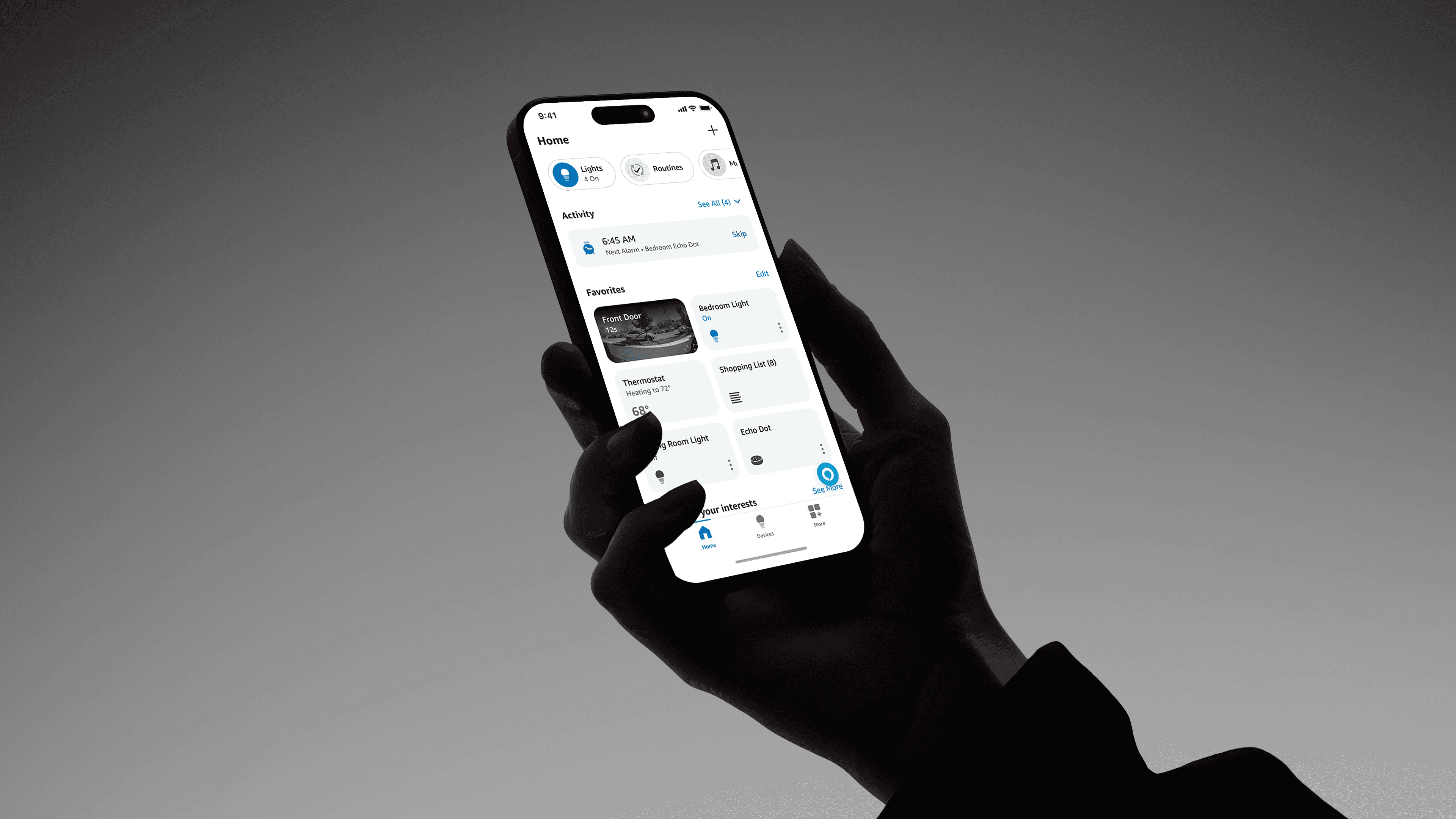
The result was a scalable, component-driven UI framework centred around adaptive cards. Designed to accommodate dynamic AI responses, the system surfaces relevant content, recommendations, contextual information and next actions while preserving clarity throughout the conversation. It creates a seamless bridge between voice and touch, providing a flexible foundation that scales consistently across mobile, Echo devices, Fire TV and the web.
200M+ Prime members reached with the global launch of Alexa+.


Post-Launch Challenges
Customers who subscribed to Alexa Plus were overwhelmed into a long and un-intuitive onboarding process, requiring them to set up features that did not align with their goals (i.e Motivation).
Without understanding customer motivations, such as why they subscribed to Alexa Plus, the onboarding experience felt unfulfilling and unintentional. It was like shooting a dart blindly in the dark, hoping it hits the target.

Post-Launch Challenges
Customers who subscribed to Alexa Plus were overwhelmed into a long and un-intuitive onboarding process, requiring them to set up features that did not align with their goals (i.e Motivation)


Framer Inc. is a software company that provides a platform for designing and building interactive websites and prototypes with ease.
Company
PepsiCo x Amazon
Timeline
2025
—
2025
Role
Web Designer
Duration
Team
Overview
Framer approached us with a clear vision: to create a flagship template that would stand out in the crowded Framer ecosystem. The goal was to design something bold yet refined, a template that could become the go-to choice for creative studios looking to present their work with authority. This project became Fortex, a template that merged sleek editorial-inspired layouts with flexible components, offering both distinct personality and practical usability. The mission was to make Fortex feel like more than a website starter—it had to embody the creative standards of the very agencies that would use it.
Challenge
The greatest challenge was balancing personality with adaptability. Framer wanted Fortex to be striking enough to attract attention, but also flexible enough to work across a wide variety of studios, from small design teams to established agencies. Typography and layout required a careful push-and-pull between bold experimentation and timeless polish. On the technical side, the challenge lay in crafting smooth, expressive interactions that enhanced the experience without bloating performance. Another complexity was ensuring the template could be customized easily by non-technical users, a requirement that demanded precision in component structure and documentation.
Alexa+ set out to change this by replacing command-based interactions with natural, contextual conversations. This introduced a new UI challenge: how do you design an interface for conversations that are different every time?
Working closely with UX designers, voice designers and engineers, I helped create a scalable, component-driven UI system that could adapt to evolving AI responses, surface relevant content and follow-up actions, and seamlessly bridge voice and touch while preserving clarity and conversational context across the Alexa ecosystem.
Designing the foundation
The programme began with an intensive cross-functional vision phase involving Product, UX, Voice Design, Engineering, Research and Content Design. Together, we defined Alexa+'s conversational principles, interaction model and long-term product vision.
Over the following 18 months, multiple teams worked in parallel to transform those principles into production-ready experiences. Through continuous prototyping, customer testing and close collaboration across disciplines, we refined interaction patterns, validated new concepts and evolved a shared design system capable of supporting an expanding set of AI-powered experiences.
Option 01. Conversation View as a panel over native UI.
Option 02. Agent embedded in a left-hand nav rail.
Option 03. Floating Action Button above all UI.
Option 4. Mid-fidelity concept. Widgets, content and smart home in one view.
Final design before public launch interface.
The result was a scalable, component-driven UI framework centred around adaptive cards. Designed to accommodate dynamic AI responses, the system surfaces relevant content, recommendations, contextual information and next actions while preserving clarity throughout the conversation. It creates a seamless bridge between voice and touch, providing a flexible foundation that scales consistently across mobile, Echo devices, Fire TV and the web.
200M+ Prime members reached with the global launch of Alexa+.
Post-Launch Challenges
Customers who subscribed to Alexa Plus were overwhelmed into a long and un-intuitive onboarding process, requiring them to set up features that did not align with their goals (i.e Motivation).
Without understanding customer motivations, such as why they subscribed to Alexa Plus, the onboarding experience felt unfulfilling and unintentional. It was like shooting a dart blindly in the dark, hoping it hits the target.
Post-Launch Challenges
Customers who subscribed to Alexa Plus were overwhelmed into a long and un-intuitive onboarding process, requiring them to set up features that did not align with their goals (i.e Motivation)